Präsens: Your first sentences using the present tense in German
2 min readLevel A1by Alba
Today we will take a look into how we can build easy sentences using the present tense in German. Once you learn this simple pattern, you can build hundreds of simple sentences right away.
Today we will take a look into how we can build easy sentences using the present tense in German. Once you learn this simple pattern, you can build hundreds of simple sentences right away.
The most used pronouns
In our examples today we will be using only the following pronouns to refer to the person that does the action. These are the most used pronouns in casual conversations between two people.
Ich = I
Du = You (informal, one person)
Er = He
Sie = She
An easy way to get the verb stem
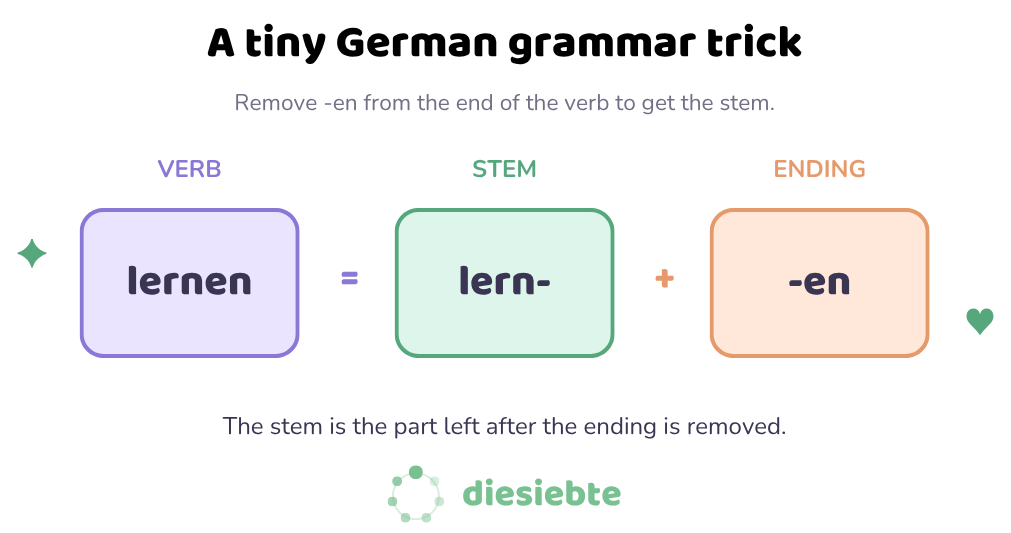
Every German verb has a base stem and an ending. The ending depends on the pronoun, but the stem never changes.
To see how this works, let's take the verb lernen (to learn). If we remove the "-en" at the end of the verb, we get the stem "lern-".
Before we start talking about the present tense, look into these common verbs and write their stems:
Fill the gaps
Write the stems of the following verbs.
Use the verb stem to create the present tense
Add the new ending based on who is doing the action. This is the pattern:
Ich (I) + STEM + -e: Ich lerne
Du (You) + STEM + -st: Du lernst
Er (He) + STEM + t: Er lernt
Sie (She) + STEM + t: Sie lernt.
Notice that we use the same ending for "er" and "sie".
Let's do some practice with the verb "kommen":
Fill the gaps
Conjugate the verb "kommen" (to come).
And now with the verb "wohnen":
Fill the gaps
Conjugate the verb "wohnen" (to live) in the present tense.
Easy!
I hope you got everything right.
To make sure you have learnt something useful in this lesson, let's put these verbs and more into simple sentences in a conversation. You will encounter a verb that we haven't seen in this lesson, which is heißen (to call yourself).
Try to fill the gaps in the following sentences using the present tense in German as explained in this article:
Fill the gaps
Type the missing words, then check your answers.
Words to use
- kommst
- trinke
- Machst
- heißt
- heiße
- komme
- wohnst
- spiele
- machst
- lerne
- wohne